
CABO DA ROCA – THE EDGE OF EUROPE
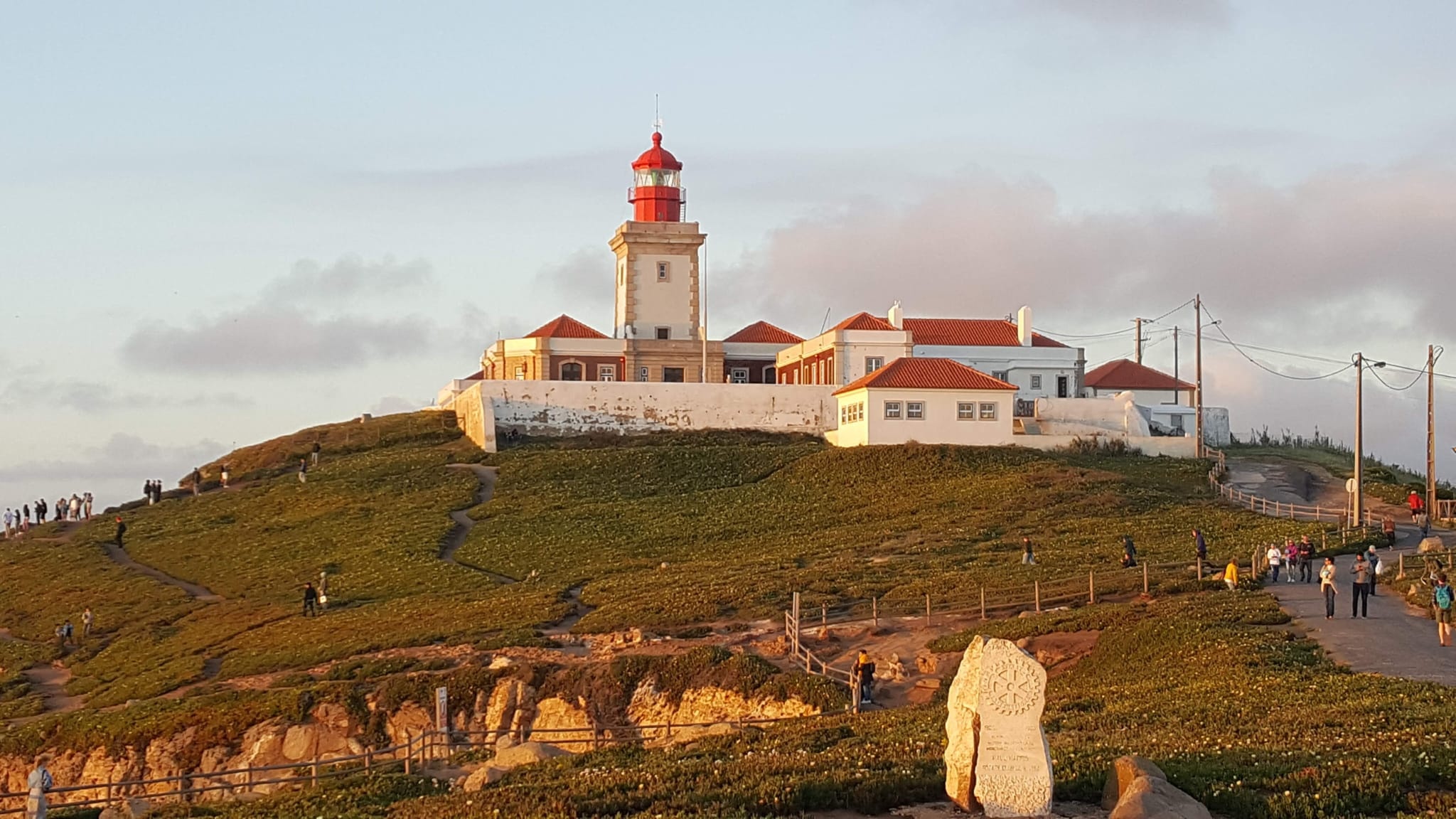
Cabo da Roca – The Edge of Europe
Cabo da Roca marks the westernmost point of continental Europe. Standing over the Atlantic at 140 meters above sea level, it embodies both natural majesty and cultural symbolism — the meeting point between land, ocean, and history.
Where is Cabo da Roca located?
Situated within the Sintra-Cascais Natural Park, Cabo da Roca belongs to the parish of Colares in the municipality of Sintra. It lies approximately 40 km from Lisbon and 18 km from Cascais.
What makes this location geographically important?
Its coordinates — 38°46′51″N, 9°29′54″W — officially mark the western edge of mainland Europe. From its cliffs, the Atlantic horizon seems infinite, a sight that once guided explorers toward the unknown.
What landscapes surround Cabo da Roca?
The site combines rugged granite cliffs, wind-shaped vegetation, and panoramic sea views. The Serra de Sintra rises to the east, while coastal trails lead toward Adraga and Ursa beaches.
What is the historical and cultural significance of Cabo da Roca?
What was its name in ancient times?
Romans called it “Promontorium Magnum,” the Great Promontory, a navigational landmark already known in antiquity.
How did it gain national symbolism?
In the Age of Discovery, it became a poetic frontier of the known world. Luís de Camões described Portugal as a land “where the land ends and the sea begins,” a verse now engraved on the monument’s plaque.
What symbolizes the monument at the cape?
A stone cross and engraved plaque display its coordinates, standing as a national symbol of exploration and endurance. Visitors can purchase a commemorative certificate authenticating their presence at Europe’s westernmost point.
What natural features define the cape?
How high are the cliffs?
The cliffs rise around 140 meters above sea level. Their vertical walls, carved by constant Atlantic winds, reveal layers of granite and metamorphic rock.
What flora and fauna exist here?
Native shrubs and low maritime plants cling to the rocky soil. The site hosts seabirds and occasional peregrine falcons, adapted to the strong coastal winds.
How does erosion shape the coastline?
Powerful Atlantic waves continuously reshape the cliffs, slowly retreating the coastline over centuries. This dynamic geology gives Cabo da Roca its dramatic visual appeal.
What role does the lighthouse play?
When was the Cabo da Roca Lighthouse built?
Constructed in 1772, it remains one of Portugal’s oldest coastal lighthouses. The red lantern stands 22 meters high and emits a light visible more than 40 km offshore.
What is its function today?
It continues to serve as a maritime navigation aid under the Portuguese Navy, ensuring safety along one of Europe’s busiest Atlantic routes.
Which trails and beaches can be explored near Cabo da Roca?
Cabo da Roca Hike – Walking along the cliffs
Several hiking paths follow the cliffs connecting Cabo da Roca with other scenic viewpoints. Trails are signposted and vary from easy to moderate difficulty, offering 360° views of the Atlantic.
Trails to Praia da Ursa
Praia da Ursa lies just 1 km north, accessible by a steep but rewarding footpath. Its rock formations, including the “Bear Rock,” make it one of the most photographed beaches in Portugal.
Trails to Praia da Adraga
To the south, Adraga Beach is reachable through marked coastal trails. The route traverses rolling dunes, limestone ridges, and sea-view ridgelines, ideal for experienced hikers.
What experiences await visitors at Cabo da Roca?
Watching the sunset over the Atlantic
Cabo da Roca is one of the best sunset locations in Portugal. The light fades behind the ocean, illuminating the cliffs in gold and crimson — a daily natural spectacle.
Visiting the viewpoint and monument
The viewing area near the monument offers panoramic views and safe access paths. From here, one can observe the continuous movement of waves hundreds of meters below.
Cabo da Roca Restaurant
Near the main parking area, a traditional restaurant serves local seafood, offering visitors a comfortable pause after exploring the cape and nearby trails.
Visitor certificate and shop
At the on-site shop, travelers can obtain a personalized “Cabo da Roca Certificate” — a symbolic document confirming their visit to the western edge of Europe.
How to get to Cabo da Roca?
From Lisbon
By car: approximately 40 minutes via A16 or IC19 to Sintra, then N247 to Cabo da Roca.
By public transport: train from Rossio to Sintra (~40 min), followed by bus 403 toward Cascais (stop: Cabo da Roca).
From Sintra
Bus 403 departs regularly from Sintra station toward Cabo da Roca. Wondervan.pt private tours often include the cape as part of a full-day Sintra itinerary.
From Cascais
Bus 403 also connects Cascais to Cabo da Roca in about 25 minutes. The coastal drive passes through the Cresmina dunes and Guincho Beach — scenic routes worth the detour.
What makes Cabo da Roca unique?
How do its natural and human elements interact?
The combination of geological monumentality, poetic heritage, and maritime function defines its uniqueness. Granite cliffs meet cultural memory; a functioning lighthouse stands beside a centuries-old plaque celebrating discovery.
Why is it part of the Sintra-Cascais Natural Park?
The cape forms the park’s western limit, integrating marine biodiversity, rare vegetation, and protected landscapes within one UNESCO-listed cultural territory.
What does Cabo da Roca represent to visitors?
It represents both the physical edge of Europe and a symbolic edge of imagination — a place where geography meets wonder, perfectly suited to the cultural traveler.
FAQs about Cabo da Roca
What is the entrance fee?
Access to Cabo da Roca is free of charge.
Can you visit the lighthouse?
The lighthouse itself is not open to the public, but it can be admired from outside.
What are the nearby attractions?
Praia da Ursa, Praia da Adraga, Azenhas do Mar, and Sintra’s palaces are all within short driving distance.
Can I visit Cabo da Roca on a guided tour?
Yes. Wondervan.pt offers private and group tours from Lisbon or Sintra, often combining Cabo da Roca with Sintra’s royal palaces and Atlantic beaches.
What should I bring?
Comfortable shoes, a windproof jacket, and a camera — the winds are strong, but the views are unforgettable.